(Note: you can click on photos for larger versions)
| "St Ives, Cornwall" |
(St Ives, Cornwall, Saturday, 15th July 2000, 8.30 p.m. )
Despite another night in an extremely comfortable hotel and the calming wash of the waves outside, I had a bad night's sleep - the second in a row, and I spent most of the day feeling rather dazed and tired. But, looking out of the window, it was a beautiful day to wake up to, nonetheless, with the sky and sea in an ever-changing dance of color and morning light. Since I couldn't get back to sleep, and it was still quite a while before breakfast, I made the best of a bad thing, and caught up with some email.
I haven't been able to send email since Thursday because my dial-up software has suddenly started to malfunction. That, by the way, is only one of a series of technical problems I've suddenly had to confront, after weeks of incredible luck. The other two problems are that my mini camera tripod is gradually falling apart, and, much more seriously, my good Kodak camera has finally become unusable. Yesterday, it was providing blurry pictures: by mid-morning today, the photographs were coming out a complete blur. That kind of puts an end to anything to but "holiday snap" type photos for the rest of the trip.
By 8.30, I was gobbling down a passable cooked breakfast, admiring the view out of the dining-room window, and before long, I was out on the beach to explore. There isn't actually any sand at all on the beach: it consists entirely of pebbles and stones, mostly the latter. Rising up from the beach are tall cliffs completely covered with vegetation, looking more like the cliffs of a sub-tropical island than something english. This impression was reinforced when I came across a waterfall running down the side of the cliff right onto the beach.
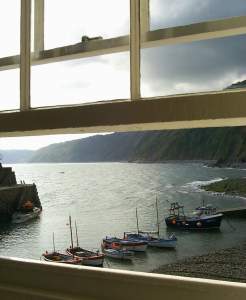
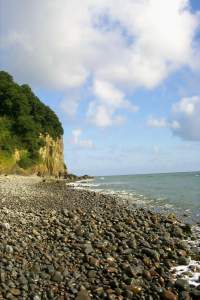
On the beach.
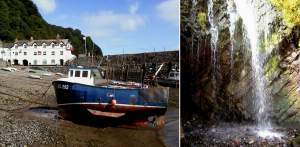
Fishing boats left on the beach by the receding tide (with my hotel in the background), and the waterfall running down the cliff right onto the beach.
The village, Clovelly, itself is remarkable. The main street essentially climbs right down the cliff-side, lined with white-washed houses and gardens full of colorful flowers, providing the only break in the cliffs. The street is, obviously, of necessity, very steep, and in fact, it's not negotiable at all by vehicles, and is made up of a series of roughly cobbled steps. Deliveries of goods to the shops and houses seem to be made by a sort of wooden sled that gets dragged down the steps. It's an ancient fishing town, and generation upon generation of the same few families are buried in the local cemetery.
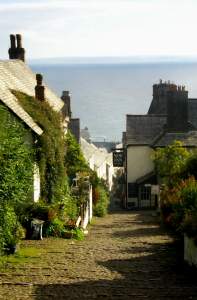
Clovelly Street
I almost wished I was staying here two nights - particularly with the weather, it would have been a lovely place to relax and explore. Nevertheless, I packed up and headed out, driving west again, further down the leg of Cornwall, to Tintagel, another jewel of a village perched on high cliffs. I'd come here for two reasons: first, many scenes of a novel by one of my favorite authors, Anthony Trollope, take place at the ruined castle in Tintagel. Second, that same ruined castle is not only set on a precarious cliff on the sweeping, dramatic, cornish coastline, but it's also, by legend, the birth-place of King Arthur.
Nobody really knows, even, if there was a King Arthur: it's certainly a legend that's become mixed up by centuries of story-telling and fancy. For instance, the connection of Arthur to Tintagel came about first in a story that was made up in the 12th century. But in 1998, a team of researchers discovered a stone, apparently dating from the 7th century, which bore an inscription that could be interpreted as saying, in effect, "Arthur woz here". The people of Tintagel are obviously very happy about this since it's boosted tourism no end. You can't help wondering if someone planted the stone, particularly after you've seen photos of it, where the writing appears just a shade too precise and obvious: but who am I to know.
The setting of the castle could not be more dramatic. You head down from the town, along a curving path towards the sea, which takes you by surprise, because the castle is supposed to be on a cliff-top. Suddenly, near the bottom of the path, the ravine opens up, and on the headlands above you on either side you see ruined walls. Paths have been laid built to take you back up the cliffs, and from these steps you get incredible views of the ravaged cornish coastline, with the white surf beating against cave-marked cliffs.
Once you reach the castle walls, they're the most ruined walls imaginable: it's hard to accept they've stood here only 800 years (the castle itself is not a part of the Arthurian legend)- they look much older. Apparently there are hundreds more barely visible remains of buildings all over these wild headlands, many of the buildings dating to roman times, and some to the 600s or 700s, the times of Arthur.
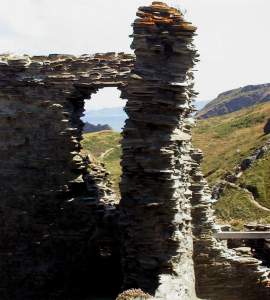
The ruined walls of Tintagel Castle
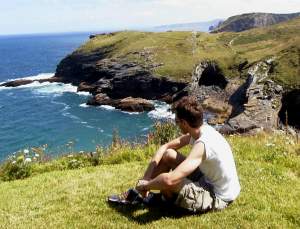
Looking out on the rugged coastline. You can see one of the largest caves just above my head.
I'm going to have to come back to this part of the country and explore it at greater leisure. You can walk for miles along the cliffs: although you probably wouldn't want to do it today since, out of the protection of the castle walls, a cold wind had set up. And besides, today, I was too tired for much in the way of walking. I decided to make my next stop St Ives, and check in to my hotel early, and just spend the rest of the day relaxing or sleeping. I certainly needed it! Fortunately, there's a pretty good freeway running towards Penzance for much of the length of western Cornwall, so I was able to get to St Ives by two-thirty.
I found my hotel easily: it's just on the outskirts of town, overlooking the whole bay and the town, which curves around to a promontary. In the beautiful, clear, blue light, the white sand and the green shallows off the beach made a gorgeous site. It would have been perfect to just lie on the roof-deck of the hotel and snooze in the sun; but the wind was actually still rather too cool for that - in fact the weather reminded me strongly of a summer day in San Francisco!
Despite the beauty of its position, St Ives is not a particularly remarkable town: seen from above, it's actually rather untidy looking, with the roofs of the houses covered with a mess of orange moss and seagull droppings. Yet, with the quality of the light, the colors of the sea, and the romantic, savage cliffs of the nearby coastline, it's had a reputation as one of the most significant artists' colony in the country, which explains why the Tate has set up an annex here.
St Ives is, though, primarily still a beach town - the lack of free spaces in the parking lots which I circled during the afternoon is not due to a rush of visitors at the Tate. I'm not much of a beach person anyway - my reasons for coming here are that it made a good stopping off point for exploring Lands End and Penzance, as well, of course, to see the museums. Part of enjoying the beauty of the scenery is seeing it reflected in the work of artists influenced by the same scenery.
I managed to squeeze the Mercedes into a tight spot finally, at the cost, I admit, of a tiny scratch which I'll hope they won't notice when I return it! The Tate is perfectly sited, right above the beach, squarely facing the bay, and it invites the sea right into the galleries by virtue of its many picture windows and open spaces. It's quite something to be looking at paintings influenced by the sea while you're in a spotless, clean, white gallery flooded with the blue light of the sea. The first show I saw was was of a famous local naive fisherman-cum-artist (now deceased I think) named Alfred Wallis. He was a little too naive for my taste. Call me a philistine, but I couldn't see any technique - one art critic's "naive" style is another person's inability to get beyond schoolboy painting (in my humble opinion of course :). The two other shows were of a great series of meditative photos representing St Ives, by Diane Cumley (I think - I can't read my writing again), and a small collection of wonderful representative works by three other artists who have been foremost in the "St Ives School".
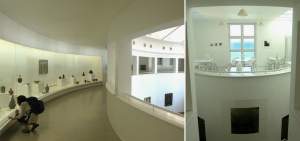
Inside the Tate St Ives
Finally, common sense dictated that I should go back to my hotel and take a long nap! Which I did, for around three hours! When I woke up, the color was just beginning to fade from the sky and sea and I lay on the window-seat in the window of my room gazing out at the view.