(Note: you can click on photos for larger versions)
| "Devon Coast" |
(Clovelly, Devon, Friday, 14th July 2000, 10.24 p.m. )
Right now I can hear only the rythmic swish of the sea on the pebble beach about 80 yards in front of my window. But it took a long time to get here today! I started, of course, in Bath this morning, and set off early since I knew it would be a long day.
Sometimes, the Frommer guidebooks can be sadly dissapointing. They discuss an obscure church with an interesting relief in the same measured tones as they discuss a natural wonder like Cheddar Gorge, which I visited mid-morning: I almost decided not to visit Cheddar, but Frommer's lack of excitement not-withstanding, I'm glad I did.
Approaching Cheddar, you wouldn't expect to find anything too exciting, since the roads are relatively obscure, narrow and not heavily trafficked. But the first sign of something exotic is when you suddenly find yourself driving through a deep gorge, which gets deeper and more spectacular with each turn of the road. Then you break suddenly as mountain goats fill the road. Mind, the only reason I label them "mountain" goats is that I discovered their droppings high up during my later ill-advised clamber up an unmarked path to the top of the gorge. The goats, it turned out, were wise to take the road, since the path became finally too steep and muddy for me, and I got rather dirty during my scramble back down to the car.
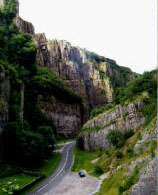
In Cheddar Gorge, the largest, deepest gorge in England. In the picture, you can see my car far below. By the way, my camera was functioning particularly badly today - almost all of the photos came out slightly out-of-focus.
After returning to my car and washing off, I continued my drive through the gorge, not knowing what to expect next. You turn another bend in the road, and suddenly the gorges descend rapidly and on either side of the road, the old village of Cheddar appears, with large parking lots, and a ticket booth for entry to the Cheddar Caves. (And you thought Cheddar was only famous for the cheese!) There are two main series of caves, and I picked up the entire history of the caves and, incidentally, the town of Cheddar, from Derrick, the friendly, talkative owner of a cheese-shop where I stopped to buy gifts for friends. After telling me that his wax-sealed cheddars would travel no-problem for three weeks in my suitcase, he told me that a century and a half ago, the town was a sleepy dairy town until one day, a "black fellow" fell through the earth and accidentally discovered the first of the big cave complexes. Another fellow, a sea captain, discovered the second, larger series of caves and since he wasn't black (I'm guessing here) his caves were named after him. There then followed a digging frenzy as the extent of the caves was realized, and the hope that rich tourists would spend to gain entrance. Their hopes proved true, and Cheddar was put on the map (although most people still seem to expect to find only cheese here!)
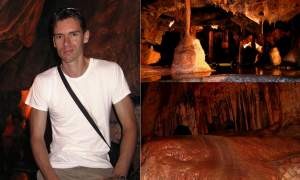
In the caves. It's funny, but some of the rock formations look remarkably like melted cheese with crackers. I'm not kidding - they really do! Other parts of the cave are so smooth that they look like the sort of caves they knocked up weekly on the Paramount sound-stages for Star Trek. Apparently, underneath the existing cavens, there are miles of passageways under the large river that still flows underground.
Before leaving Cheddar, I stopped in the official cheddar-cheese factory to confirm that the cheeses Derrick happily sold me would indeed last for three weeks in my suitcase, and they just laughed in my face - no way! Oh well, I was had.
From Cheddar, it was only a few miles to Wells, the famous Cathedral town, and England's smallest city. A friend of mine lives there, and, since I hadn't seen him in a while, and had never visited Wells, I was looking forward to the afternoon.
While we caught up with each other, my friend gave me an extensive tour of the Palace, the palace grounds, and the Cathedral, pointing out bits of history, and interesting architectural details which I'd have never known otherwise. It's getting late (tonight as I write), so I'll just summarize a little: the exterior of the Cathedral isn't by any means the most striking of the many I've seen on this trip, but the interior is certainly the most beautiful, taken as a whole. It's filled with arches, and particularly interesting are the structural braces that were added later as the weight of the tower started causing it to sink into the ground. One wall of the cathedral contains the World's second oldest working clock, which is a true marvel: it's been keeping good time for 800 years! It has little mechanical figures that dart around each time it strikes, and the clock has two faces - one inside, and one outside. Finally, the palace gardens are probably the best-landscaped examples I've seen.
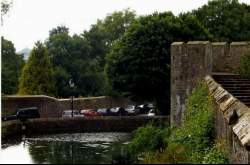
The walls of the garden around the Bishop's Palace, and beneath it, the moat. The moat is filled from an adjcaent natural spring (which gave Wells its name). In a gap between the two trees at the very left of the pic, you can barely make out a distant hill with a tower on it - that's Glastonbury Tor, some five miles away: more on that later.
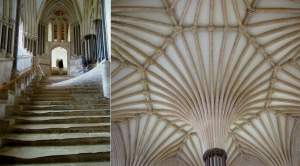
Left, the beautiful steps leading up to the Chapter House, and right, the large, intricate ceiling inside the Chapter House.
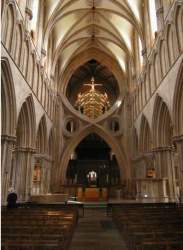
Looking down the main body of the Cathedral, with one of the three structural braces supporting the tower.
By four-thirty, it was time for me to get on the road again. It had been a lovely afternoon, and a pleasure to see how happy and in-the-right-place my friend seemed in his life at Wells.
Another few miles down the road lies another renowned Christian site, Glastonbury, which has been the site of places of worship for longer than almost anywhere else in Europe. It's also known as the Ancient Isle of Avalon, since it sits on a plateau that was, at some distant point in history, an island surrounded by marshes. Just outside the city center, and visible for miles around (remember, I could see it from the Bishop's Palace in Wells), is Glastonbory Tor. A "tor" simply means a "hill", in the local dialect, and, alone, the hill itself, in this case, is remarkable. Hundreds of feet high, yet rather small in circumference, and hence, very steep. Yet even more unusual, sitting on the very top is a ruined church tower. And this tower replaced the even older chapel of St Michael, which was actually destroyed in an earthquake in 1275. Strangely enough, the top of the tor is thronged with enormous cows. I'm not sure how they got up here, since the sides of the tor are so steep.
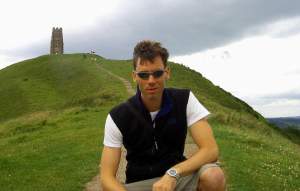
Half way up Glastonbury Tor. As I was climbing up, I felt the increasing power of the wind, which was blowing straight from the North: it was pretty darned cold, and the wind had enough strength to blow my mini camera tripod over. (At least it wasn't raining today, but keep your fingers crossed for tomorrow, which is St Swithen's Day - in British folklore, if it rains on St Swithen's Day, it will rain for forty days thereafter!)
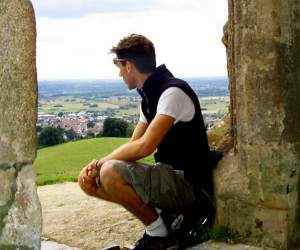
Sheltering from the wind, just inside the open interior of the ruined church tower. This would be an awesome place to be for a beautiful sunset, or on a pitch-black clear night.
The afternoon was getting very long, however, and I still had a long way to go to reach my hotel for the night, which is way over on the North Devon coast. So I didn't linger long atop the tor, and was soon heading west on the A39, winding my way through gorgeous little villages and, later through the magnificent loneliness of Exmoor National Park, with its high, bleak hills plunging into a grey sea.
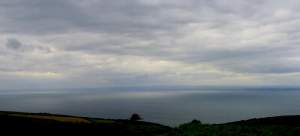
Looking out to sea, not long before sunset, from the heights of Exmoor. The clouds were casting a misty white streak through the sea.
By 9.00, I'd made it to the outskirts of Clovelly, and I was suddenly curling down an extremely steep, winding, single-land road to the hotel, which is right on the small, stone quayside. What peace! And what a remarkable day - such sights, and such beauty. I haven't begun to do it justice - you had to be there!
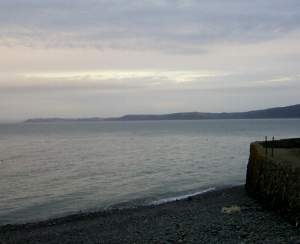
The view after sunset from my hotel bedroom.