(Note: you can click on photos for larger versions)
| "Thrilled Again by 2001" |
(San Francisco, Sun, Dec 9, 2001, 2:11 PM )
I recently went to the Castro Theater to see the new 70mm print of "2001". It has only been shown in three cinemas across the country, and the Castro chose a defining moment at which to show it, since they're closing down right after the final performance in order to renovate the luscious (but faded) interior, provide a new sound system (thank God) and (hopefully) rip up the horrible seats and replace them.
Despite the poor sound, and the uncomfortable seats, there's nowhere else I prefer to go to see a special movie. It always attracts a sophisticated, lively crowd. You don't have people shouting out "kill the bitch!", but you do hear people hissing at baddies (especially Republican baddies), and laughing uproariously at anything even remotely camp.
As Brett and I listened to the organist before the movie started, I hoped he'd at least play the Blue Danube, in honor of the movie. And I wasn't dissapointed. What I didn't really expect (but secretly hoped for) is that he'd also have the nerve to tackle the opening of Also Sprach Zarathustra (the massively grand, instantly recognizable opening title music to 2001). Right at the time when the organist normally strikes up "Open Your Golden Gates", you heard, rising out of the quiet, that low rumbling that comes just before the opening chord of Zarathustra. And then he let rip with the whole thing, while the audience cheered, and the organ slowly descended into the pit. It was a marvellous moment; that alone was worth the admission price.
There's such a magic to this movie for me. There are three distinct moments where I feel a rush of tears. And in fact even describing them now sends goosebumps down my back. The first is the very opening, where, to the tune of the opening theme, you see, as if you're hovering above the moon's surface, the sun rise from behind distant Earth. The Zarathustra theme seems almost as if it was written for that moment. Whenever I hear that theme I wonder how it must have sounded to its first audience in the 1880s. I wonder if its magnificence knocked their socks off. Or whether it was so different and unexpected that they hated it.
The second moment that gets me, and this is perhaps the most powerful single moment in all of cinema, for me, is right at the end of the "Dawn of Man" sequence, where the triumphant man/ape tosses his bone high up into the sky. The camera follows the bone until suddenly, with what has been described as the longest jump cut in motion picture history, you see a space ship floating in the stars. It's an idea that could only be conveyed by film.
Much of the movie is ... well, I almost hate to say that it's boring, but it is rather slow and chilled. Kubrick seemed a little too interested in the mechanics of imagining future space living. The characters might as well be androids for all the emotion they convey. But I continue to return to this movie every few years so that I can reexperience the journey Kubrick takes you on. The ending is open to everybody's interpretation, but that's the final of the three moments that thrills me. Zarathustra strikes up again, and you see the Earth glowing from space. Slowly, out of the corner of the screen you see the eyes-wide embryo child in its protective bubble approaching Earth, and watching over it. I won't spoil your own private interpretation of what it means by giving you mine; and, in fact, I'm not sure I can quite put into words what that scene makes me think and feel; but it's one of those rare moments of high art that you don't experience very often.
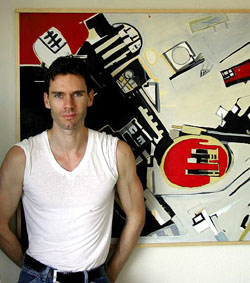
Speaking of art, today's photograph is of the new piece of art I just bought. It's the first original painting I've bought in about five years. It's by a very talented, bright guy I've been getting to know recently.