(Note: you can click on photos for larger versions)
| "The Lake District" |
(Oxenholme, The Lake District, Wednesday, 5th July 2000, 1.34 p.m. )
As I write, I'm being rattled side to side on the speedy Virgin Trains run (that Richard Branson has his finger in every pie) from Edinburgh to Oxenholme. Despite the bumpy ride, I'm really feeling very comfy - I have a delicious hot breakfast bun and a hot cup of coffee, I have a little section of the coach to myself, with plenty of leg-room, and the scenery outside is becoming ever prettier as we approach the Lake District.
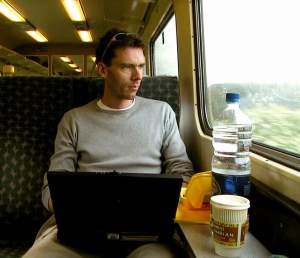
On the train running fast towards the Lake District
At three-thirty this morning, though, I was dreading this journey. I just couldn't get to sleep, and hence I was anticipating feeling ill and deadly fatigued today, as I struggled through three separate train-rides with my heavy luggage. But I managed to get to sleep eventually, slept through my alarm clock, had another wonderful cooked breakfast, and, right now at least, feel fine, and happy to be on my way towards a favorite part of Britain for which I have treasured memories.
But first, though, I can't leave bonny Scotland without saying again what a fine city Edinburgh is. It should be on any traveler's list of top European destinations: it has everything - a long, fascinating history, great museums (which I didn't have enough time for), monumental buildings, beautiful parks, great shopping, and magnificent countryside all around. And that's not to mention that it's also one of the cheapest destinations in Europe. I paid only fifty pounds per night for my great stay in a Georgian B&B ("Sibbet House"), and that included so many little extras such as full cable TV (rare in hotels here), and extraordinary hospitality from the host Jim Sibbet and his french wife Aurore (who did my laundry free-of-charge after I asked her where the nearest laundromat was).
When I was a kid, my family wasn't poor, but we weren't completely middle-class comfortable either. We didn't own a car, didn't have many clothes in our wardrobe, and hardly ever took vacations. The first vacation I recall was when I was around eight, and we went to Ambleside, in the Lake District. It was such an exciting idea - we even got new clothes! I remember that it was probably the first time my mother bought me a pair of jeans, and how proud I was of the velvety feel of the brushed denim, and having all those pockets!
Some of my happiest childhood memories come from that vacation, and another one we took again a couple of years later to the same spot. I remember being woken up early by my Dad, and setting off with him in the early morning mist for a long hike up Wansfell, the tall hill right next to Ambleside, and how we saw a massive eagle sore suddenly above our heads. Best of all, I remember the whole family playing a raucous game of soccer on the lawns at Waterhead, and my amazement that Mam could actually run!
But I'm not coming here this time for a nostalgia fest, more for the space and beauty of it. Last year, when I toured New England for a couple of weeks, I felt the link between art and countryside scenery, and it's given me a greater appreciation of both. The Lake District was really "discovered" (as a tourist destination, at least) by the Pictaresque Movement in the late eighteenth century, where poets and painters were inspired by the unparalleled contrasts between the hills, the lakes, and the slate-roofed houses of the villages. It's not that the mountains and lakes are themselves, individually, that impressive; rather it's the scale of the whole thing, with small lakes bound on all sides by small mountains (the largest being just over 3,000 feet high). And the changeable weather, and particularly the morning fogs, mean that no view is ever the same. Of course, it's overrun with tourists, but it's possible to escape them all, like I did that morning with my Dad. My one concern about the trip is that the grey weather is likely to mean I won't be able to take very good photographs, since my cameras don't function well in this kind of light.
Ambleside, The Lake District, Wednesday, 5th July 2000, 7.37 p.m.
Now, I'm sitting in the garden that belongs to the hotel's pub, waiting for my dinner. It's a nice evening, but I'm the only one who's chosen to sit outside - I guess everyone else would rather sit inside inhaling cigarette smoke and listening to "Jessie's Girl" on the jukebox :). Out here, apart from occasional passing cars, all you can hear are the crows, and they're loud enough. I can just see the tops of some nearby grey-green hills through the houses.
It's amazing how small Britain seems now that I've lived in the States. As a kid, I imagined places like Edinburgh and the Lake District to be vast, impassable distances apart. Yet it took me barely three hours to get here, and by three o'clock this afternoon, I'd already unpacked, and I was running through a park on the edge of this touristic village. Soon I was in fantasy countryside, with a brook babbling along the path, and sheep in the sloping, rocky fields, each field separated by a wall made up of slivers of slate just stacked without cement. In the distance, I caught my first glimpse of the cluster of mountains that line the horizon: I think one of them is called "Old Man Coniston". I ran past a field, and there was a gorgeous brown horse pawing the grass beside the fence. I was filled with joy as he suddenly galloped along the field to the gate at the other end, so that he could wait for me: but as I didn't have an apple for him, he gave me a baleful, hungry stare and galloped off again.
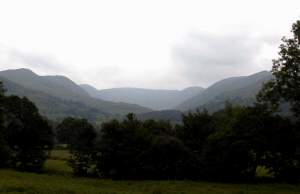
First glimpse of the mountains.
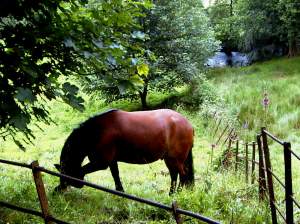
The horse that galloped along with me for the length of a field.
Finally, my run turned up hill, past the church at Rydal where William Wordsworth, worshipped, and it was time to turn back. I was pretty much wiped out, but what a wonderful place to go running!
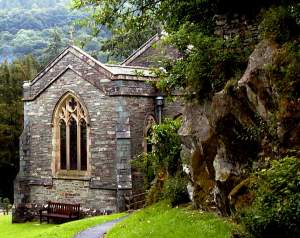
The church in Rydal where William Wordsworth worshipped.
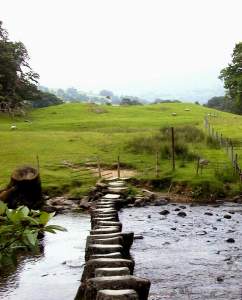
Stepping stones across the River Rothay
It's nice to find that despite my own memories of Ambleside, and the warnings in the guidebooks, Ambleside isn't totally destroyed by tourism. Sure, in the village center, you're competing for sidewalk space. But on my run, I'd seen few cars or hikers, and, towards the end of the afternoon, when I hiked up to Stockghyll Force, I was almost alone.
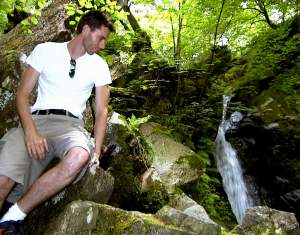
Overlooking part of Stockghyll Force
Thinking of Stockghyll Force, reminds me that one of the joys of the Lake District is the language, and in particular its use in place names. Mountains like Skiddaw, Blencathra, Helvellyn, and the names of the lakes Windermere, Buttermere. Indeed the word "mere" means a lake, and "force" means a waterfall, while "fell" means a mountain. With all that, it's always a little dissapointing to find that most residents talk with almost a Lancashire accent, and don't use funny words :)
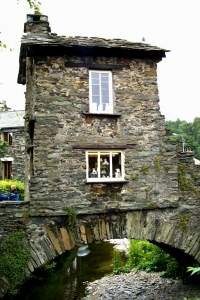
Ambleside's most famous site, the Bridge House.