(Note: you can click on photos for larger versions)
| "The Tate Modern" |
(London, Wednesday, 21st June 2000, 9.34 p.m. )
I'm running out of superlatives. Brilliant, perhaps? To describe the new Tate Modern, I mean, which I visited today. It could also be described as a great act of institutional generosity to give Londoners access to such a wonderful public space. I'm beginning to feel, on this trip back to Europe, a bit like a caveman suddenly transported to a land of wonders. I'm afraid San Francisco is going to seem rather pale: it's much trumpeted new musem of modern art wouldn't even fit in this building's lobby. Inevitably, I'm beginning to think I should move back here. It probably won't happen - at least not any time soon; after all, I think I had similar thoughts after recent visits to New York, Boston and Washington D.C. Despite my love for San Francisco, though, culturally, it's a backwater.
When I arrived at the museum shortly before opening time, there was a most unenglish clustering of people. You'd think you were in Italy - none of the ordered queueing we go in for in this country :) I was feeling a little cold in the blustery wind under a grey sky broken with scudding clouds. Across the river, St Pauls was grey too, as was the Thames itself, flowing sluggishly underneath the new pedestrian bridge which was visibly swaying in the wind. This brand new bridge was opened while I was in Italy, then closed again two days later on account of its unexpected tendency to make pedestrians feel as if they were on the deck of a heaving ship!
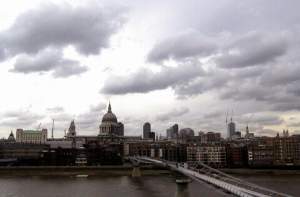
St Pauls and the Millenium Bridge from the Tate Modern
A few minutes later, the doors to the museum slid open, and the reason for the lack of a queue became clear - it was unnecessary. Admission is free! We all walked through the open doors and found ourselves at the top of an immense ramp, which gently descends through the colossal turbine hall (the museum is in a converted power station) - this must undoubtedly be the biggest open space in any museum in the World. I found myself stunned at the space, walking down the ramp with the face of a five-year old on his first day at school. It felt more like going to St Peters than to any museum. I immediately began to wonder if the collection could possibly match the building. But I guess that would be okay for me, in this space - I had a similar reaction when I went to the new Getty in Los Angeles.
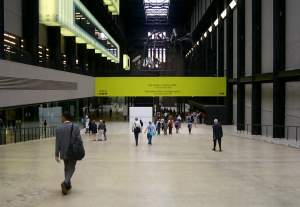
Descending the ramp into the Turbine Hall. Notice the glowing boxes clamped high up the wall. Some of these turn out to be intimate little reading rooms.
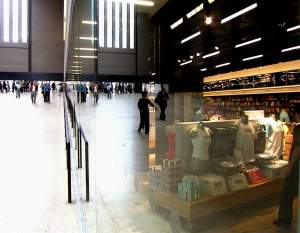
The enormous main store, and looking back up the ramp to the entrance.
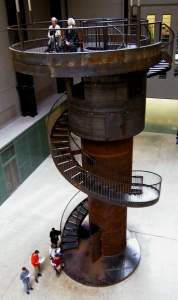
One of three iron art installations you can climb up in the turbine hall.
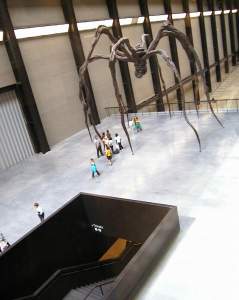
It's behind you! Another iron piece on the platform in the middle of the turbine hall.
There are two floors of galleries - interconnected rooms of all shapes and sizes: high-ceilinged spaces with other large installations, smaller rooms with each work carefully annotated and interpreted for you, and most rooms with views across the Thames through the tall thin windows that line the original building. I only saw half of the permanent collection this morning (since it's free, I can come back to see the rest later), and enjoyed many of the works, despite the distraction of the building - it's an integrated experience, though, not like a normal visit to an art museum.
Some of the works are presented with obvious and detailed care - like a series by Mark Rothko in a darkened gallery with two comfortable benches (one of which I swear was mistaken for an artwork by an old lady who was staring at it for minutes). The artist would be thrilled, I imagine, to have his works presented in a way that so carefully communicates his original intentions for the paintings to affect you in much the same way as a room by Michelangelo (the Laurentian Library) in Florence.
Other pieces I really liked included the enormous "Water-Lillies" by Monet, a luxuriously large, meditative piece, in which you could sense the quiet joy with which the artist must have created it; Bridget Riley's head-splitting, colorful, geometric designs; sculpture by Anthony Carr (if I can read my hand-writing correctly!) that had the beauty of a brand new piece of complex industrial equipment before its soiled by use; and a tower of frosted vases and cups by Tony Cragg. The one piece that really stood out for me, though, was an installation of something like fifty customized cardboard boxes by Susan Hiller, each containing a carefully presented set of objects that, without the presentation, would have meaning only to herself. Imagine taking the the time to mount and show off in your living room the knick-knacks from the bottom drawer in your chest-of-drawers, and finally get others to feel how you feel about them, and you'll get the idea.
Whenever I visit a truly memorable, inspiring museum like this, I'm left with the itch to create art myself. This happened last when I visited the Reine-Sofia (I think it's called) museum in Madrid. Unfortunately, the inspiration, that last time, didn't outlast the flight home - probably a good thing considering my complete lack of artistic technique. So visitors to my apartment will likely be spared again this time :) But if I show photos of "found objects" when I'm in the Lake District in a couple of weeks, don't be surprised :)
After all that art consumption, I needed some protein and carbohydrates to go with it. I went to Leicester Square to buy a half-price ticket for a theater matinee, and then wandered over to Old Compton Street and ate outside, shivering in my t-shirt in the cool wind only a little :), at the Stock Pot. It was interesting to people watch, and there were some pretty boys to ogle, but everyone seemed to be in such a hurry, and everyone had a mobile phone shoved firmly up their butt (must be most uncomfortable!)
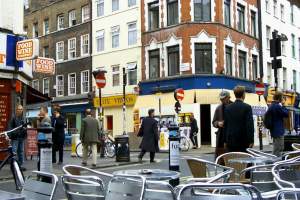
People watching from the Stock Pot on Old Compton Street
London has changed by an inconceivable amount since I lived here in the mid-eighties. Stylish restaurants have bloomed in every odd crack in the slightly sleazy Soho neighborhood which I explored after lunch, and they sit side-by side now with sex shops and traditional street- markets (which are unchanged in decades)
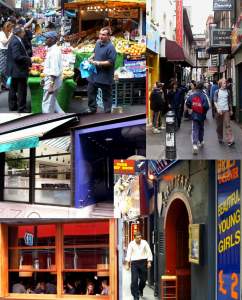
The big mix in Soho
The play I went to see in the mid-afternoon was "Dolly West's Kitchen" by Frank McGuinness, at the Old Vic, possibly London's most famous theater. I'm not a great fan of theater: personally, it's too mannered for my taste (there would be some outrageous "stage pauses" in today's performance). But, sitting only three rows from the stage, I could truly imagine all the great actors who've played here - Olivier, Gielgud, Ralph Richardson, Alec Guiness. In fact, most of my fellow audience members probably remember seeing those actors as young men - it was one of those grey-haired audiences.
The play was set during the Second World War in a small port in the Irish Free State, and showed the lives and loves of a colorful, middle-class family. It's the various love interests that provide the melodramatic conflict - two young American GIs who visit the town; and the long lost love of Dolly West, an Englishman who's just about to join the British Army. There are a wealth of cross-currents: the Irish hatred of the English, and mistrust of the Americans, the strength of all the female characters, and the self-hatred of the son, who's the only man left in the family, but who covers his latent homosexuality with his strident anti-English rhetoric.
The acting was mostly excellent - especially the matriarch of the family, played by someone called Pauline Flanagan - apart from the guy who played the Englishman. I felt like I knew the actor, but couldn't place him until I read the program. He played the character of Tarrant in a seventies British science-fiction show "Blake's Seven", and his acting hadn't improved despite twenty years of practice. The two Americans were good-looking guys, of course: the one who played the gay GI (who, naturally, falls for the gay son) even has a webpage. But the actor, Harry Carnahan, who played the other GI, was stunning - the eyes of Paul Newman and the physique and looks of the young Marlon Brando - he left me breathless. Wish he had a webpage! (2008 note - he still doesn't have a webpage, and, poor thing, has only four movies on IMDB.com in one of which he played a waiter. And no photos.)
Overall, I'd give the play a B+ - the melodrama got a bit too tortured and self-indulgent I thought. The play did touch me, however - it made me think about love, family, and what it must have been like for my parents to live through the war. Towards the end, two characters sing both verses of the great English hymn "I Vow to Thee my Country" to each other, which, since I love that hymn, was a particularly poignant moment for me.
When I came out of the theater, the weather had turned even stranger. It was cold and overcast one moment, then blue sky would swing rapidly into view again. By the time I reached my hotel room, the clouds had largely cleared. But there's a lot more rain in the forecast. (Oh goodie :)
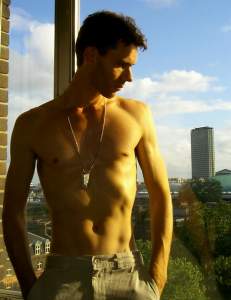
Sunshine conquers the evening sky